

Life Choices of Memphis

The abortion pill in Tennessee

Whether you can legally get the abortion pill depends on your state. In Tennessee, you can't.

See your options, side by side

When you're ready, free in-person help in Memphis is here.

If you'd rather talk to someone now, call (901) 388-6262.

How the abortion pill works, and what Tennessee law says. Safe, confidential, and free.

Start here

The short version

  • You can't get the abortion pill in Tennessee. Abortion services are not available here at any stage of pregnancy. Telehealth visits for abortion aren't available either.
  • It's two medicines, not one pill, taken a day or two apart. It's only used early on.
  • Cramps and bleeding heavier than a period are expected. The heaviest part tends to last a few hours. Lighter bleeding can go on for days.
  • Two things matter before anything else. How many weeks along are you, and is the pregnancy in your uterus? A limited ultrasound confirms the pregnancy and shows how far along you are.
  • The follow-up check is how you know the pregnancy has fully passed and that you're healthy.
  • We offer a free pregnancy test. We can also tell you how abortion works, including the abortion pill. Call or text (901) 388-6262 at any hour.

What happens when you come in

  1. Call and pick a time

    Call (901) 388-6262 and we'll find a time that works.

  2. Free pregnancy test

    It takes minutes, and you get the result while you're here.

  3. Free ultrasound if you want one

    It shows how far along you are.

  4. Talk through your options

    We go through what each option involves, including how abortion works.

What the abortion pill is

It's not one pill. It's two medicines, taken a day or two apart, and they're only used early on.

The first blocks a hormone the pregnancy needs to keep growing. The second, taken a day or two later, makes the uterus cramp and empty. You may also hear it called medication abortion. That means the same thing.

It only works in a short, early window, so how far along you are decides if it applies to you at all.

What state law says

Abortion services are not available in Tennessee at any stage of pregnancy. So you can't get the abortion pill here. Telehealth visits for abortion aren't available here either.

There's one narrow medical exception, and the law section spells out just what it covers. Laws also change, so check the current rules with a licensed provider or a lawyer.

A lot of what you find online won't match your case. That's because national sites describe what you can get in other states.

Abortion laws in Tennessee

This is the law in Tennessee, where this center is. If you live somewhere else, it's your own state's rules that apply to you.

Abortion is prohibited in Tennessee. That is how a KFF analysis of state policies and court decisions lists it, as of April 27, 2026. Performing or trying to perform one is a felony. The woman herself cannot be convicted or punished for that crime. There is a medical exception, set out below. It does not cover any reason tied to her mental health. Some care is not counted as an abortion for this crime. That includes ending an ectopic or molar pregnancy or removing a dead fetus. This is general information, not legal advice.

  • Whether abortion is legal here: The Tennessee General Assembly's own record of this law says that, as enacted, it enacts the Human Life Protection Act, which prohibits abortion in this state, effective on the 30th day after the U.S. Supreme Court overturns Roe v. Wade or an amendment to the U.S. Constitution allows states to prohibit abortion. The same record says the law creates an exception for situations where the abortion is necessary to prevent the death of the pregnant woman or prevent serious risk of substantial and irreversible impairment of a major bodily function, and that it prohibits prosecution of a woman upon whom an abortion is performed or attempted. The bill was assigned Public Chapter Number 351.
Show all 17 details
  • How the 2023 changes were recorded: The Tennessee General Assembly's record for Senate Bill 745 says that, as enacted, the bill makes various changes relative to abortion, and that the companion bill has been assigned Public Chapter Number 313 by the Secretary of State. The record's bill history line reading "Comp. became Pub. Ch. 313" is dated 05/03/2023.
  • What the law calls an abortion, and what the crime is: This act shall be known and may be cited as the Human Life Protection Act. It adds a new section to Tennessee Code Annotated, Title 39, Chapter 15, Part 2, and that section defines abortion as the use of any instrument, medicine, drug, or any other substance or device with intent to terminate the pregnancy of a woman known to be pregnant, with intent other than to increase the probability of a live birth, to preserve the life or health of the child after live birth, or to remove a dead fetus. Medicine and drugs are named inside that definition, so it is not limited to a procedure. Where the statute uses its own term for what is developing in a pregnancy, this page says embryo or fetus; that section defines the term as an individual living member of the species homo sapiens, throughout the entire embryonic and fetal stages, from fertilization until birth. The same section says a person who performs or attempts to perform an abortion commits the offense of criminal abortion, and that criminal abortion is a Class C felony.
  • Who the law punishes: The Act says this section does not subject the pregnant woman upon whom an abortion is performed or attempted to criminal conviction or penalty. It also says medical treatment provided to the pregnant woman by a licensed physician which results in the accidental death of, or unintentional injury to or death of, the embryo or fetus is not a violation of the section.
  • The medical exception: Tennessee Code Annotated section 39-15-213 is amended by deleting subsection (c) and substituting a new subsection. The first paragraph of that new subsection, numbered (c)(1), says that, notwithstanding subsection (b), a person who performs or attempts to perform an abortion does not commit the offense of criminal abortion if the abortion is performed or attempted by a licensed physician in a licensed hospital or ambulatory surgical treatment center and two conditions are met. First, the physician determined, using reasonable medical judgment, based upon the facts known to the physician at the time, that the abortion was necessary to prevent the death of the pregnant woman or to prevent serious risk of substantial and irreversible impairment of a major bodily function of the pregnant woman. Second, the physician performs or attempts to perform the abortion in the manner which, using reasonable medical judgment, based upon the facts known to the physician at the time, provides the best opportunity for the embryo or fetus to survive, unless, using reasonable medical judgment, termination of the pregnancy in that manner would pose a greater risk of death to the pregnant woman or substantial and irreversible impairment of a major bodily function. In that second condition the statute uses its own term for what is developing in a pregnancy, and this page says embryo or fetus.
  • Mental health and that exception: The same subsection says an abortion is not authorized under subdivision (c)(1)(A), and a greater risk to the pregnant woman does not exist under subdivision (c)(1)(B), if either determination is based upon a claim or a diagnosis that the pregnant woman will engage in conduct that would result in her death or the substantial and irreversible impairment of a major bodily function, or for any reason relating to the pregnant woman's mental health.
  • What serious risk to a major bodily function means: Tennessee Code Annotated section 39-15-213(a) was amended to add definitions. Serious risk of substantial and irreversible impairment of a major bodily function means any medically diagnosed condition that so complicates the pregnancy of a woman as to directly or indirectly cause the substantial and irreversible impairment of a major bodily function. The definition says it may include previable preterm premature rupture of membranes, inevitable abortion, severe preeclampsia, mirror syndrome associated with fetal hydrops, and an infection that can result in uterine rupture or loss of fertility. It says it does not include any condition related to the woman's mental health. The same amendment defines inevitable abortion as a dilation of the cervix prior to viability of the pregnancy, either by preterm labor or cervical insufficiency.
  • Ectopic and molar pregnancy: Tennessee Code Annotated section 39-15-213(a)(1) is amended by adding the language "to terminate an ectopic or molar pregnancy," before the language "or to remove a dead fetus".
  • Ultrasound steps in section 39-15-215: Prior to a pregnant woman giving informed consent to having an abortion as required by section 39-15-202, the physician shall determine the gestational age of the embryo or fetus, inform her of that age, perform an obstetric ultrasound, auscultate the fetal heartbeat of the embryo or fetus, if any, so that she may hear the heartbeat if the heartbeat is audible, provide a simultaneous explanation of what the ultrasound is depicting, display the ultrasound images so that she may view them, record the presence or absence of a fetal heartbeat in her medical record, and obtain from her a signed certification that she was presented with the required information, that she viewed the ultrasound images or declined to do so, and that she listened to the heartbeat if the heartbeat was audible or declined to do so.
  • Which of those sections are superseded: Tennessee Code Annotated section 39-15-213 is amended by adding a new subsection saying that, while section 39-15-213 is in effect, this section supersedes sections 39-15-211, 39-15-212, 39-15-214, 39-15-215, 39-15-216, 39-15-217 and 39-15-218. Section 39-15-215 is named in that list.
  • If you are under 18: a parent's consent: Tennessee Code Annotated section 37-10-303(a) carries a parental consent requirement for a minor to have an abortion. A 2006 act, which took effect on July 1, 2006, made it a Class A misdemeanor to impersonate the parent or legal guardian of an unemancipated minor for the purpose of circumventing that requirement. The same act says the person performing the abortion shall obtain some written documentation, other than the written consent itself, that purports to establish the relationship of the parent or guardian to the minor, and shall retain that documentation, along with the signed consent, for at least one year. Failure to obtain or retain them is a Class B misdemeanor, punishable only by a fine, unless the failure to retain was due to a bona fide, imminent medical emergency to the minor.
  • If you are under 18: what the court rule covers: A court rule promulgated under Tennessee Code Annotated section 37-10-304(i) governs petitions for waiver of parental consent for abortions by minors, and says those proceedings are to be conducted in an expeditious and anonymous manner. Under the rule, an applicant is a pregnant female less than eighteen years of age and not emancipated, or a person acting as next friend on her behalf. The proceeding is commenced by filing a petition in the Juvenile Court of any county of this state. The proceedings governed by the rule shall be confidential and the record shall be sealed. Except as provided in Section 5(c) of the rule, the identity of the applicant shall not be disclosed at any stage of the proceeding, and in all documents and proceedings she is identified or referred to only by the initials of her first and last name. Section 5(c) says one copy of the petition shall contain the complete true name of the minor applicant, shall be filed with the court, and shall be kept in a separate file under seal that is not open to inspection by anyone except as provided in Tennessee Code Annotated section 37-10-304(h). An applicant has the right to court-appointed counsel, and upon request the court shall immediately appoint counsel to assist her. No filing fees or court costs shall be required of the applicant. The petition asks the court to enter an order authorizing a physician to perform an abortion upon the applicant without first obtaining parental consent. This court process can waive the consent requirement. It does not create an exception to the prohibition in the Human Life Protection Act.
  • If you have a pregnancy emergency: the emergency room: A hospital emergency department, including a satellite emergency department, shall not deny to a woman who presents there and purports, or if incapacitated appears, to be pregnant and experiencing active labor, other symptoms associated with active labor, or an emergency medical condition, an appropriate medical screening examination within the capability of the emergency department, to determine whether an emergency medical condition or active labor exists.
  • What the emergency room rule does not change: That section says it does not authorize an abortion unless the conditions in 39-15-213(c) are met.
  • Consent and the 48 hour wait in section 39-15-202: Tennessee Code Annotated section 39-15-202 is amended by deleting the section in its entirety and substituting new text, in an act that shall take effect July 1, 2015. The substituted text says that, except in a medical emergency that prevents compliance, no abortion shall be performed or induced upon a pregnant woman unless the woman has provided her informed written consent, given freely and without coercion. Except in a medical emergency that prevents compliance with that requirement or with any of the items listed under it, it also says no abortion shall be performed or induced unless she has first been informed orally and in person, by the attending physician who is to perform the abortion or by the referring physician, of a list of facts, and has signed a consent form acknowledging that she has been so informed. That list includes that according to the best judgment of her attending physician or referring physician she is pregnant, the probable gestational age of the embryo or fetus, that numerous public and private agencies and services are available to assist her during her pregnancy and after the birth of her child if she chooses not to have the abortion, and the normal and reasonably foreseeable medical benefits, risks, or both of undergoing an abortion or continuing the pregnancy to term. The text then says that, except in a medical emergency that prevents compliance, no abortion shall be performed until a waiting period of forty-eight hours has elapsed after that information is provided, including the day on which the information was provided, and that after the forty-eight hours have elapsed and prior to the abortion the patient shall sign the consent form. It adds that if any court temporarily, preliminarily or permanently enjoins enforcement of that waiting period, or declares it unconstitutional, the waiting period shall be twenty-four hours, subject to the same medical emergency exception, and that if the injunction or declaration is subsequently vacated or reversed the waiting period shall revert to forty-eight hours. It defines a medical emergency, for those requirements, as a condition that, on the basis of the physician's good faith medical judgment, so complicates a medical condition of a pregnant woman as to necessitate an immediate abortion of her pregnancy to avert her death, or for which a delay will create serious risk of substantial and irreversible impairment of major bodily function. These rules do not create an exception to the prohibition in the Human Life Protection Act.
  • The 2023 correction to that cross-reference: This amendment deletes "subdivision (c)(2)(B)" in subdivision (c)(2) in SECTION 2 and substitutes "subdivision (c)(1)(B)".
  • Status of abortion in Tennessee: A KFF analysis of state policies and court decisions, as of April 27, 2026, lists the status of abortion in Tennessee as prohibited, with an exemption for life and physical health.

Sources: [1][2][3][4][5][6][7][8][9][10][11][12][13][14][15] · Last verified 2026-10-31. Laws in this state are changing; confirm current rules.

What happens in your body

After someone takes the pills, cramps and bleeding follow. That's the medicine working, not a sign that something has gone wrong.

  • The bleeding tends to be heavier than a period, and it often has clots.
  • The heaviest part tends to last a few hours.
  • Lighter bleeding or spotting can go on for days, sometimes a week or two.
  • Nausea, chills, feeling tired, or a short, low fever are common for a day or so.
  • All of this changes from person to person.

Get medical care right away if bleeding soaks through two full sanitary pads an hour for two hours in a row. Also get care right away if pain keeps getting worse instead of easing, or if a fever won't come down.

Two things to find out first

A home test can't tell you either one, and both change which options are open to you.

How many weeks along you are. Dates from memory are often further off than people think. This option only exists early on.

Where the pregnancy is growing. Sometimes it grows in a fallopian tube instead of the uterus. The abortion pill doesn't treat that. Its cramps and bleeding can look like the medicine working while the real problem goes on. Go to the ER now if you have sharp pain low down or on one side, pain in your shoulder, or you feel faint.

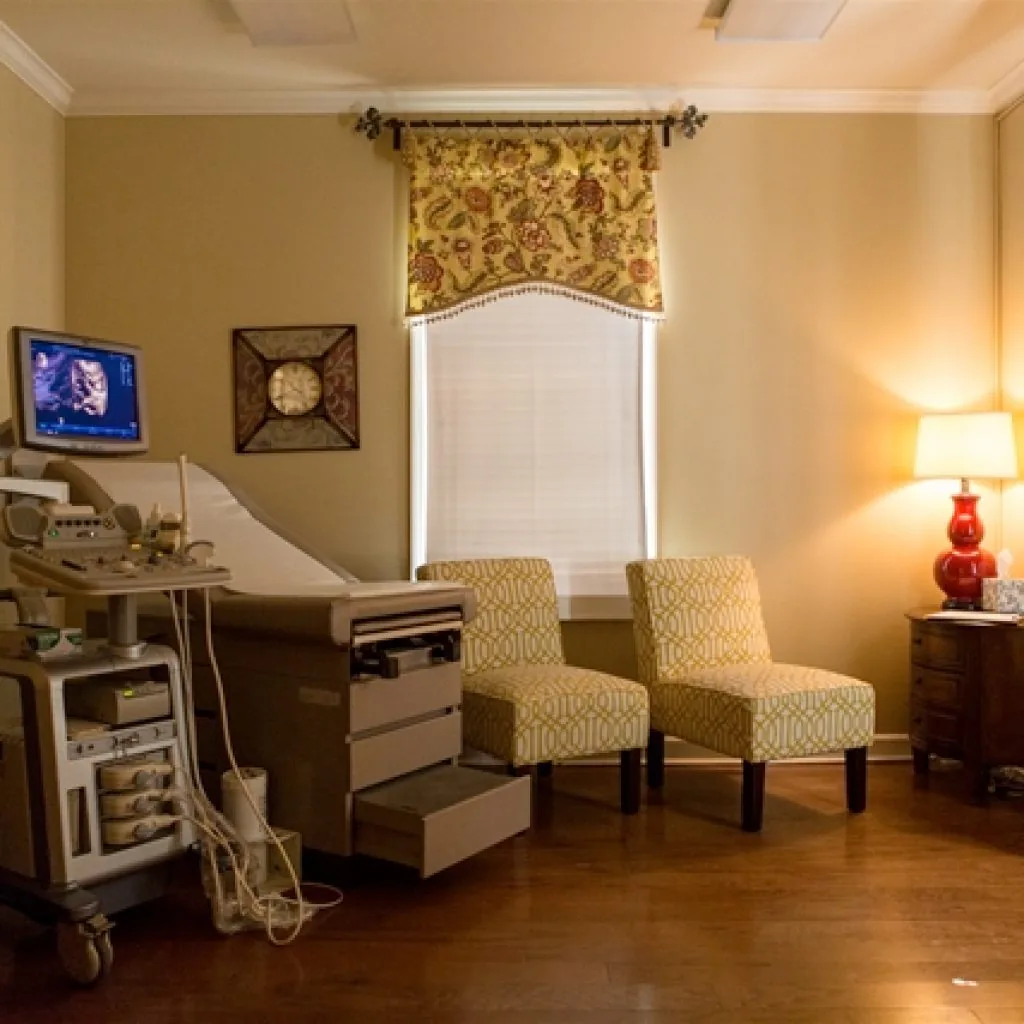
A limited ultrasound checks both at once. It confirms the pregnancy and puts a number on the weeks. It only answers those two questions and doesn't look for other problems like a full scan does. Very early on, it can't always give a sure answer. We're at 5575 Raleigh-LaGrange Rd in Memphis. Call or text (901) 388-6262 at any hour. You can often get in the same day or the next.

Why you need the follow-up check

The process isn't over when the bleeding stops. A follow-up check is how you know the pregnancy has fully passed and that you're healthy.

Two things can happen in a small share of cases. Tissue can stay behind, or the pregnancy can go on even after both pills. Neither one always gives you a sign, so feeling fine afterward doesn't prove it's over. The table below shows how often each one happens.

If this has already happened and something feels wrong, you don't have to work it out alone. We have someone you can talk to after an abortion. Call or text (901) 388-6262 at any hour.

What the evidence supports

You'll find strong claims both ways online.

How people feel afterward isn't the same for everyone. Relief, sadness, and mixed feelings are all common. If you want to talk any of that through, call or text (901) 388-6262.

A fully informed decision

Your options, side by side

Each option below says what it involves and what people weigh before they choose it. Life Choices of Memphis does not perform or refer for abortion.

The abortion pill (medication abortion), not available in Tennessee, with one narrow medical exception

What this option involves

  • Ends the pregnancy with medicine instead of a procedure
  • It happens at home, over hours, not in a clinic
  • No anesthesia is used

What to consider

  • The FDA approves it up to about 10 weeks. So how far along you are decides if it applies
  • The medicine doesn't treat an ectopic pregnancy, which is one growing outside the uterus. So where it's growing has to be checked first
  • Cramps and bleeding heavier than a period. They're heaviest for a few hours, then ease over days
  • You'll need a follow-up check to confirm the pregnancy has fully passed

How often this happens

Tissue stays behind and a short procedure is needed to finish
about 20 to 50 out of 1,000 in early pregnancy · ACOG, reviewed 2026-06-25
What to know: Keep the follow-up visit even if nothing feels wrong, because that's how this gets found. Before then, call a provider for heavy bleeding that starts again after it had settled, or cramps that don't ease. Also call for a discharge that smells bad, or a fever of 100.4F or higher that lasts more than 4 hours.
The pregnancy goes on after both pills
about 10 to 30 out of 1,000 in early pregnancy · FDA, reviewed 2026-06-25
What to know: Pregnancy symptoms that don't stop, or very little bleeding at all. Only a follow-up check can tell you either way, so go even if you feel fine.
A serious problem that needs urgent care, counted for both abortion methods together
fewer than 10 out of 1,000 in early pregnancy · ACOG, reviewed 2026-06-25
What to know: Get medical care right away for bleeding that soaks through two full sanitary pads an hour for two hours in a row, or for pain that keeps getting worse instead of easing.
Parenting

What this option involves

  • You raise your child
  • You keep your legal rights as your child's parent
  • There's support for parents near you

What to consider

  • Staying pregnant comes with its own care: checkups, giving birth, and healing after
  • It changes your school, your work, and your money for years. You'll need to sort out childcare and housing
  • You may not know yet if the people around you will really help
  • It's common to feel worn out and have doubts in the early months, even when you're sure of your choice

Adoption

What this option involves

  • Your child is raised by a family you help choose
  • Open, semi-open, and closed plans are different, and you get a say in which one
  • Nothing is binding until you sign the consent after birth

What to consider

  • Staying pregnant comes with its own care: checkups, giving birth, and healing after
  • Once you sign the consent after birth, it's final in most cases. The exact point changes from state to state, so ask before you sign
  • Some states won't enforce open-contact agreements, so a court may not make anyone keep what was promised
  • Grief is common even when the decision feels right

Who we are

Life Choices of Memphis

Life Choices of Memphis

Life Choices of Memphis is a free pregnancy medical clinic in Memphis, Tennessee. Counselors and medical staff give you confidential care at no charge. Someone answers the phone day or night.

5575 Raleigh-LaGrange Rd, Memphis, TN 38134

Call or text any time. Same-day and next-day appointments are often available.

(901) 388-6262

Life Choices is a safe, confidential, and free pregnancy help medical center.

Sources and medical review

Sources

Questions we hear

Can I get the abortion pill in Tennessee?

No. Abortion services are not available in Tennessee at any stage of pregnancy. So you can't get the abortion pill here. You can't get it through a telehealth visit either. There's one narrow medical exception, and the law section spells out what it covers. Laws change, so check the current rules with a licensed provider or a lawyer.

How early does the abortion pill work?

It only works early in pregnancy. That's why the number of weeks matters so much, and dates from memory are often off. A limited ultrasound measures the weeks instead of guessing.

How long does the bleeding go on?

The heaviest part tends to last a few hours. During that time the bleeding is heavier than a period, often with clots. After that, lighter bleeding or spotting can go on for days, sometimes a week or two. If you're soaking two full sanitary pads an hour for two hours, that's different. It needs medical care right away.

What can Life Choices of Memphis do for me right now?

We offer a free pregnancy test and a limited ultrasound. We can tell you how abortion works, including the abortion pill. There's someone to talk your options through with, and someone to talk to after an abortion. Life Choices of Memphis describes itself as a safe, confidential, and free pregnancy help medical center. Call or text (901) 388-6262 at any hour.

Who will I see?
Our counselors and professional medical staff are here to offer you safe and confidential services free of charge!
Do I have to pay or commit to anything?
All of our services are available at no charge– with no strings attached. We receive no financial gain from your decision.
Is what I tell you confidential?
Patient information is held in strict confidence, and all communication is handled with utmost discretion. Life Choices is compliant with all state and federal privacy laws.

See what a free visit in Memphis includes

Life Choices of Memphis offers free pregnancy tests in Memphis, TN. You can talk with someone in private when you're ready.

See free help in Memphis